Carmen Hernández
 15/12/2025
 6 min

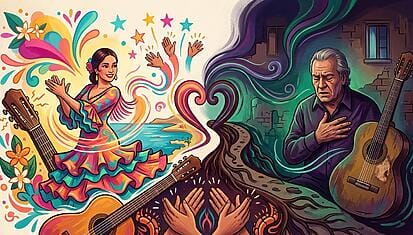
Flamenco is recognised not only by the sound of a guitar, the movement of a dancer’s hands or the rhythmic tapping of their feet. It is also present in Spanish vocabulary, expressions and culture. Words such as «duende», «jaleo» and «compás» are part of a tradition that has gone beyond the stage and found its way into everyday conversations.
From Andalusia to Japan, flamenco has captivated audiences all over the world. Did you know that one of its most characteristic instruments comes from Peru? Or that one of its greatest figures began singing as a child? Its history is full of fascinating details that help explain why this art form has left such a deep mark on the Spanish language.
An art form born from the encounter of cultures
Flamenco emerged in Andalusia as a result of centuries of cultural exchange. Different musical traditions contributed to its development, including Arab, Jewish, Castilian and Romani influences. The contribution of the Romani people was particularly important in shaping its evolution.
Its three main elements are cante (singing), baile (dancing) and toque (guitar playing). There are numerous styles, known as palos flamencos, each with its own rhythm and personality. Bulerías are fast-paced and festive, while soleá conveys deeper emotions. Alegrías, on the other hand, are particularly associated with Cádiz.
Flamenco is not limited to Andalusia. In the Region of Murcia, cantes de minas are particularly important. These styles are connected to the lives of workers in the old mining communities of La Unión. The town hosts the Festival Internacional del Cante de las Minas, one of the most renowned events in this musical genre.
In 2010, UNESCO declared flamenco an Intangible Cultural Heritage of Humanity, recognising its importance as an artistic and cultural expression.
Flamenco words we use without even realising it
Flamenco has contributed words to the Spanish language that describe emotions, sounds and situations. Some mainly belong to the world of music, while others have acquired new meanings in everyday language.
- Duende: Describes a special emotion that emerges during a performance and manages to move the audience. In everyday life, saying that someone «tiene duende» means that they have an indescribable charm.
- Compás: The rhythmic structure that organises a musical performance. It is also used to talk about the rhythm or coordination of an activity.
- Jaleo: Refers to the shouts, handclapping and exclamations used to encourage performers. Away from the stage, it means commotion or noise: «¡Qué jaleo había anoche en el centro!» (What a commotion there was in the city centre last night!).
- Taconeo: The act of producing rhythmic sounds with the heels while dancing.
- Cantaor: An artist who performs flamenco singing.
- Tablao: The stage or venue where flamenco performances take place.
Flamenco expressions we also use in everyday speech
Flamenco vocabulary has made its way into everyday conversations through expressions that have developed meanings of their own.
«Tener duende» (to have an elf) means to have a special talent or a captivating personality that makes someone stand out. You do not have to be an artist: we can also say that a city, a song or a place has duende.
«Dar el cante» (to give the singing) means to attract too much attention, usually by doing something inappropriate, embarrassing or out of place. For example: «Se presentó en la fiesta en pijama y dio el cante». (He showed up at the party in his pyjamas and attracted everyone’s attention for all the wrong reasons.)
Another expression is «Estar en su salsa» (to be in one’s sauce), which describes someone who feels comfortable doing something they enjoy. We can say that a flamenco dancer is in their element when they enjoy every movement on stage.
Great artists who transformed flamenco
The history of flamenco is full of artists who revolutionised the genre and managed to take it far beyond Spain.
Camarón de la Isla (1950–1992) is considered one of the most influential flamenco singers of all time. His album La leyenda del tiempo (1979) revolutionised flamenco by incorporating new sounds and instruments. Some of his best-known songs include «Volando voy», «Como el agua» and «Soy gitano». His nickname came about because his uncle compared his blond hair to the colour of a shrimp (camarón).
Paco de Lucía (1947–2014) was one of the Spanish guitarists best known internationally. His virtuosity expanded the possibilities of flamenco guitar. Among his most famous compositions are «Entre dos aguas», an instrumental rumba that became an unexpected hit, and «Almoraima». He also worked closely with Camarón on landmark albums such as Como el agua (1981).
Carmen Amaya (1913–1963) was one of the most important flamenco dancers in history. Her style stood out for its speed, strength and energetic footwork. She conquered stages across Europe and America and appeared in films such as Los Tarantos (1963).
Among today’s leading figures is Sara Baras (1971), renowned for her technique and elegance. Her shows Juana (2019) and Alma (2021) showcase different ways of combining tradition and creativity.
Finally, Rosalía has brought elements of flamenco to new generations. Her album Los Ángeles (2017), created together with Raül Refree, draws heavily on flamenco influences. Later, El mal querer (2018) blended traditional references with pop and experimental music in songs such as «Malamente» and «Pienso en tu mirá».
Flamenco facts you might not know
- The cajón originated in Peru. Although it is now one of the instruments most closely associated with flamenco, Paco de Lucía discovered it during a visit to the country in 1977 and decided to incorporate it into his group. Its sound fitted in so well that it eventually became a regular feature of many performances.
- Handclapping has its own technique. There are palmas sordas, which produce a muted sound, and palmas claras, which are louder and brighter. Performers combine them to accompany the rhythm.
- Feet are instruments too. Flamenco footwork alternates between strikes with the toes, heels and soles of the feet to create different rhythmic sounds.
- Japan has a great passion for flamenco. The country has academies, festivals and many students who travel to Andalusia to learn directly from flamenco masters.
A language that is also danced and sung
Flamenco shows that learning Spanish is not just about studying grammar and memorising vocabulary. It is also about discovering the stories, emotions and traditions that have shaped the language.
Words such as duende, jaleo and compás preserve part of Spain’s cultural identity. Flamenco songs, artists and expressions continue to influence the way people communicate emotions. Perhaps that is what makes flamenco so special: you do not need to understand every word of a song to feel what it conveys. Sometimes, all it takes is a guitar, some handclapping and a voice to understand that some emotions speak for themselves.