 Carmen Hernández
 6 min
6 min 
When you think of Latin America, you probably imagine tropical landscapes, delicious food, cheerful people… and music, lots of music! Latin music is much more than just background sound: it is a way of living, feeling, and connecting. From the sensuality of tango to the unstoppable energy of reggaetón, Latin rhythms have conquered dance floors all over the world.
In this article, we are going to take a musical journey through the most well-known Latin rhythms and their stories. Get ready to move your feet and learn something new.
Salsa: from the streets of New York to the heart of the Caribbean
Although salsa is often directly associated with Cuba, its true origin lies in the Latino neighborhoods of New York, especially during the 1960s and 70s. Imagine a mix of Caribbean immigrants, especially Puerto Ricans and Cubans, bringing their traditional rhythms such as son, mambo, and guaracha, and fusing them with jazz and other Afro-American sounds.
This is how salsa was born, with lyrics that speak not only about love, but also about politics, migration, and life in the neighborhoods. A curious fact: it was the record label Fania Records that helped define and popularize this genre, creating an entire “salsa movement” featuring artists such as Celia Cruz, Héctor Lavoe, and Willie Colón.
Salsa is not just music; it is dance, attitude, and community. Its fast, vibrant rhythm, full of bright brass, powerful percussion, and catchy lyrics, makes it perfect for dancing… and for falling in love!
Cumbia: the rhythm that unites cultures
Originating on the Caribbean coast of Colombia, cumbia is one of the oldest genres in Latin America. It was born as a fusion of Indigenous, African, and Spanish rhythms. Its star instrument is the flute of millo, accompanied by drums and maracas.
Over time, cumbia evolved and spread throughout the continent. In Mexico, for example, the “cumbia sonidera” emerged, more electronic and urban. In Argentina, “cumbia villera” was born, with lyrics depicting life in working-class neighborhoods.
Today, you can find cumbia in almost every Spanish-speaking country. And it is impossible not to move when it plays!
Merengue: pure Dominican energy
Merengue is the soul of the Dominican Republic. With its fast and joyful rhythm, this genre has become the national sound of the country. Traditionally, it was played with instruments such as the accordion, güira, and tambora.
During the 20th century, merengue went from rural music to filling dance halls and radios across Latin America. Juan Luis Guerra was one of the artists who helped internationalize this rhythm, giving it an elegant and poetic touch with songs about love, politics, and everyday life.
A fun fact: merengue was declared Intangible Cultural Heritage of Humanity by UNESCO in 2016. A true Latin pride!
Bachata: from rejection to stardom
Also born in the Dominican Republic, bachata was for a long time considered “bar music” or music of taverns. However, over the years, with the evolution of its lyrics and style, it earned a place in many hearts.
Instruments such as the guitar, bongos, and güira give bachata its sweet and melancholic sound. It speaks of impossible love, heartbreak, and intense passion. Romeo Santos, Juan Luis Guerra, and Prince Royce have taken this rhythm to international stages, turning it into one of the most popular genres for lovers… and for those who suffer too.
Reggaetón: from underground to global mainstream
Few genres have generated as much debate as reggaetón. Born in Puerto Rico in the 1990s, it is a mix of Jamaican dancehall, hip hop, and Latin rhythms. At first, its lyrics were raw and street-oriented, and its style was heavily criticized. But over time, reggaetón evolved, softened its language (although not always), and became a global phenomenon.
Daddy Yankee, considered the “king of reggaetón,” paved the way with songs like Gasolina. Later came artists such as J Balvin, Karol G, and Bad Bunny, who broke barriers of genre, language, and style.
Today, reggaetón is played everywhere: nightclubs, festivals, TikTok… even in major brand advertisements. Love it or hate it, it is impossible to ignore.
Tango: passion turned into music
Tango is the soul of Argentina (and Uruguay as well, let’s not forget). It emerged in the neighborhoods of Buenos Aires at the end of the 19th century, blending European, African, and Creole influences. It is a melancholic genre full of passion, drama, and sensuality.
The bandoneon, guitar, and piano are the instruments that bring this rhythm to life. Carlos Gardel was its greatest icon, and Astor Piazzolla revolutionized the genre with the so-called “nuevo tango.”
Dancing tango is not easy: it requires connection, elegance, and full commitment. But when done well, it is pure art.

Samba: Brazil’s joy
Although Brazil is not a Spanish-speaking country, it is an essential part of the Latin musical landscape. And its most representative rhythm is, without a doubt, samba.
With African roots, samba is the music of Rio’s Carnival, of samba schools, of streets full of color and feathers. It is rhythm, movement, celebration. Its percussion is unmistakable, and its spirit absolutely contagious.
João Gilberto and Carmen Miranda are among the artists who brought samba (and its close relative, bossa nova) to the world.
Did you know…?
• The word “salsa” not only refers to the musical genre but also conveys the idea of “mixture” or “flavor,” perfect to describe its fusion of rhythms.
• Reggaetón was originally called “underground” in Puerto Rico and was sold on pirate cassette tapes.
• Cumbia was banned at certain times in Colombia for being considered “vulgar,” but that did not stop its spread.
• Tango was initially rejected by the upper classes, but eventually became a national symbol.
• Bachata was for years called “music of bitterness” because of its sad and emotional lyrics.
A continent that moves to the rhythm of its history
Latin music is a reflection of our cultural diversity, our shared stories, our joys and sorrows. Each rhythm has its own essence, but they all share one thing: the ability to make us feel alive.
So the next time you hear salsa, cumbia, or reggaetón, don’t just move your body. Listen to what the music is saying. Behind every drum there is a story. Behind every accordion, a community. And behind every song, an emotion.
Latin America is not just heard. It is danced. It is lived.
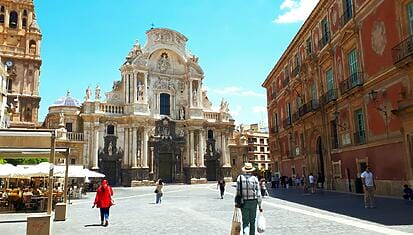
Do you want to learn Spanish and understand these lyrics from the inside? Then come study with us in Murcia and immerse yourself in Latin culture for real!