 Carmen Hernández
 6 min
6 min 
In the world of Spanish, there are words that seem to love playing tricks on us. They sound exactly the same, but have nothing to do with each other. These mischievous words are known as homophones, and although they can cause quite a bit of confusion, they are also one of the most entertaining curiosities of the language.
Do you want to know why we say “echo de menos” and not “hecho de menos”? Or why a “taza” is not the same as a “tasa”? Then this article is for you!
What does “homophone” actually mean?
Before diving in, let’s understand the term properly. “Homophone” comes from Greek:
- “homo” means same
- “phonos” means sound
So, literally, a homophone is a word that sounds the same as another word, even if it is spelled differently and has a completely different meaning.
And by the way, the word “word” itself has an interesting origin too: it comes from the Greek parabolé, meaning “comparison” or “similarity”. So we are not only playing with sounds—we are also playing with ancient roots!
Homophony: when the ear gets confused
In linguistics, we talk about homophony when two words have the same pronunciation but different meanings. In Spanish, this happens more often than you might think, especially in regions like Spain where several sounds are pronounced the same even if they are spelled differently.
For example:
- “echo” (from the verb echar, as in “I add sugar to my coffee”)
- “hecho” (from the verb hacer, as in “I have done my homework”)
When we hear them, they sound identical. But they don’t mean the same thing, nor are they spelled the same. This is where our brain—and especially our spell checker—has to stay alert.
Why do they confuse us so much?
Homophones are confusing because spoken language doesn’t show spelling differences. If someone says “hay muchas razones,” they could be using:
- “hay” (from the verb haber, meaning “there are”)
- or theoretically “¡ay!” (an exclamation, though unlikely in that context)
The real problem appears when we write them. That’s when spelling rules come into play. And if we are not sure whether it is written with h, b, or s… chaos is guaranteed!
But don’t worry—here are some examples to help you master them.
Classic examples you should know
Here are some of the most common homophone pairs (and even trios) in Spanish. They appear in exams, texts, memes… and even songs!
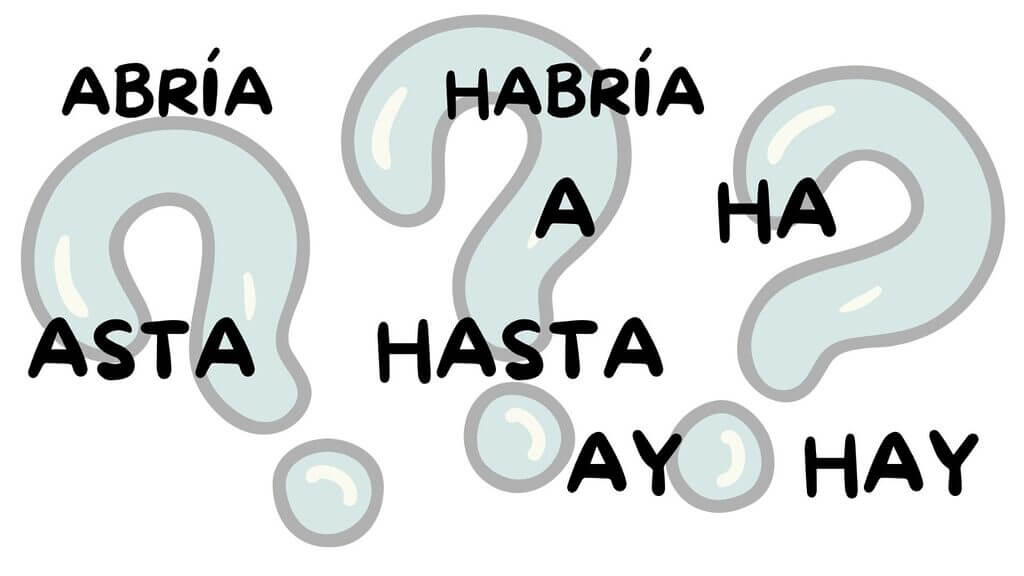
- A (preposition) and ha (verb haber)
“Voy a la playa” / “Ha llegado tarde” - Habría (verb haber) and abría (verb abrir)
“Yo abría la puerta cada mañana” / “Habría salido, pero llovía” - Hasta (preposition) and asta (horn or flagpole)
“Hasta mañana” / “El toro tenía un asta rota” - Ay, hay, and ahí
“¡Ay, qué dolor!” / “Hay muchos libros” / “El cuaderno está ahí” - Taza (cup) and tasa (tax/rate)
“Esta taza está sucia” / “La tasa de natalidad ha bajado” - Cierra (verb cerrar) and sierra (tool or mountain range)
“Cierra la puerta” / “Vamos a la sierra este fin de semana” - Cazar (to hunt) and casar (to marry)
“Voy a cazar conejos” / “Se van a casar en septiembre”
In many regions of Latin America and southern Spain, s, c (before e or i), and z are pronounced the same. This is called seseo, and it increases the number of homophones. In contrast, in parts of northern Spain where these sounds are distinguished, there is less confusion.
What about homographs?
Another interesting concept in this world is homographs. These are words that are not only pronounced the same, but also spelled the same—yet they have different meanings.
A classic example is the verb “armar”:
- “Voy a armar el mueble de IKEA” (to assemble)
- “La gente se va a armar si no hay justicia” (to arm oneself)
Or the word “vela”:
- “Enciendo una vela para decorar” (candle)
- “La vela del barco se rompió” (sail)
Here, neither hearing nor spelling helps us. Only context tells us the meaning.
How can you learn them without losing your mind?
Learning homophones can seem tricky at first, but these tips can help:
- Read a lot. Reading trains you to recognize correct spelling in context.
- Listen to audiobooks and podcasts. Try to imagine how words are written.
- Make lists. Write down homophone pairs with example sentences.
- Play games. Apps and online tools can make learning fun.
- Don’t be afraid of mistakes. Everyone has written “echo” instead of “hecho” at some point.
Did you know…?
- Homophones exist in many languages. In English: “pair” and “pear”. In Italian: “sai” and “sei”.
- In Spanish, the silent h increases homophones (like “ola” and “hola”).
- Many jokes and puns rely on homophones. Example: “What does one cup say to another? — Cup later!”
- Poetry also uses homophones to create double meanings and wordplay.
Why does all this matter?
It may seem like a simple linguistic curiosity, but mastering homophones improves your writing, reading comprehension, and speaking skills. If you’re learning Spanish as a foreign language, it also helps you avoid very common mistakes.
And if you’re already a native speaker, remembering these examples will help you write more accurately and not be misled by your ear.
In summary…
Homophones are one of the most fascinating features of Spanish. They confuse us, they amuse us, and above all, they show us that language is full of nuance. Not everything that sounds the same means the same thing.
So next time you hear someone say “hecho” or “echo”, pause for a moment, think… and choose the correct word.
Ready to discover more language games? Keep following our blog at the Instituto Hispánico de Murcia and explore how fun learning Spanish can be!