Carmen Hernández
 8 min

The Spanish Civil War was a conflict that took place between 1936 and 1939, pitting the Republicans, who represented the country’s more progressive and left-wing sectors, against the Nationalists, supported by conservative and right-wing forces.
This episode in Spanish history was the result of a complex combination of political, social and economic factors that had been developing over several decades.
Origins of the Conflict
The origins of the Spanish Civil War can be traced back to the economic crisis that affected the country from the 1920s onwards. Social inequalities became increasingly pronounced during this period, with a landowning oligarchy and an increasingly dissatisfied working class. The failure of the Bourbon Restoration to achieve political and social stability, the rise of the labour movement and the emergence of new political movements, such as anarchism, socialism and nationalism, led to growing social polarisation.
Against this backdrop of instability, the dictatorship of General Miguel Primo de Rivera (1923–1930) represented an attempt to stabilise the country’s political situation. However, the lack of genuine solutions to the economic and social crisis, combined with international political instability, ultimately led to the fall of the dictatorship and the proclamation of the Second Spanish Republic in 1931.
Despite its reformist intentions, the Second Spanish Republic failed to resolve the country’s economic and social problems, or the issue of the political and cultural status of Catalonia and the Basque Country, both of which demanded greater autonomy. Against this backdrop of social discontent, more radical political parties emerged, including the CNT (National Confederation of Labour), the PCE (Communist Party of Spain), the Spanish Falange and other nationalist groups.
Most Prominent Historical Figures
The Spanish Civil War featured a large number of historical figures who became symbols of the different forces involved in the conflict. Among the most notable were:
Francisco Franco
Leader of the Nationalist faction and a general in the Spanish army. He became Head of State following the victory of the Francoist forces.
José Antonio Primo de Rivera
Founder and leader of the Spanish Falange, a political party with a nationalist and fascist ideology.
Dolores Ibárruri
Known as “La Pasionaria”, she was a prominent communist leader and a member of parliament during the Second Spanish Republic.
Manuel Azaña
President of the Second Spanish Republic and leader of the Republican side during the conflict.
George Orwell
British writer who joined the International Brigades to fight against Franco’s forces and later recounted his experiences in his book “Homage to Catalonia”.
Interesting Facts and Anecdotes
There are many interesting facts and anecdotes related to the Spanish Civil War. Some of the most notable include:
Aerial Bombings
The Spanish Civil War was the first major armed conflict in which aerial bombings were used systematically.
Karl Marx
During the war, the Republican government even issued banknotes featuring the portrait of Karl Marx.
George Orwell
As mentioned earlier, the writer George Orwell enlisted in the Republican militias and fought in the Spanish Civil War. His experiences during the conflict inspired his famous novel “1984”.
The Fiercest Battles
The Spanish Civil War witnessed some of the fiercest battles between opposing troops. During the Battle of Jarama, for example, more than 100,000 soldiers clashed in a relatively small area measuring just 25 kilometres.
The “Durruti” Battalion
The Republicans created the “Durruti” Battalion in honour of the legendary anarchist Buenaventura Durruti, who died during the war under mysterious circumstances.
Pablo Picasso
The Republican government commissioned the artist Pablo Picasso to create a mural for the Spanish Pavilion at the 1937 Paris World’s Fair. The result was his masterpiece “Guernica”.
The Lincoln Brigade
The famous Lincoln Brigade, made up of American volunteers, played a prominent role in some of the bloodiest battles of the Spanish Civil War.
The Mobile Molotov
During the conflict, the Republicans used what became known as the “Mobile Molotov”, a truck loaded with incendiary bombs that was used to attack enemy forces.
The German Condor Legion and the Italian Legionary Air Force
The Nationalists received assistance from the German Condor Legion and the Italian Legionary Air Force, which used the Spanish Civil War as a testing ground for their new warfare techniques.
Francisco Franco
One of the most controversial figures of the Spanish Civil War was General Francisco Franco, as mentioned above. He led the Nationalist uprising and eventually became Spain’s dictator for almost four decades. Despite the criticism surrounding his legacy, some people still consider him a national hero.
Key Events
The Failed Coup of 1936
On 17 and 18 July 1936, a group of military officers led by General Francisco Franco attempted a coup d’état against the government of the Second Spanish Republic. The coup failed in most parts of Spain, although it succeeded in certain regions, including Andalusia, Galicia, Navarre and most of the Canary Islands.
The Emergence of the Two Spains
Following the failure of the coup, Spain became divided into two opposing factions: the Republicans, who supported the legally established government and controlled most of the regions, and the Nationalists, who supported the rebels led by Franco and controlled a large part of the armed forces and the Catholic Church.
The International Brigades
During the Spanish Civil War, thousands of foreign volunteers, many of them communists, socialists or anarchists, travelled to Spain to fight against Franco and his allies. The International Brigades were made up of people from different nationalities, including Americans, British, Germans, Italians and French, among others.
The Siege of Madrid
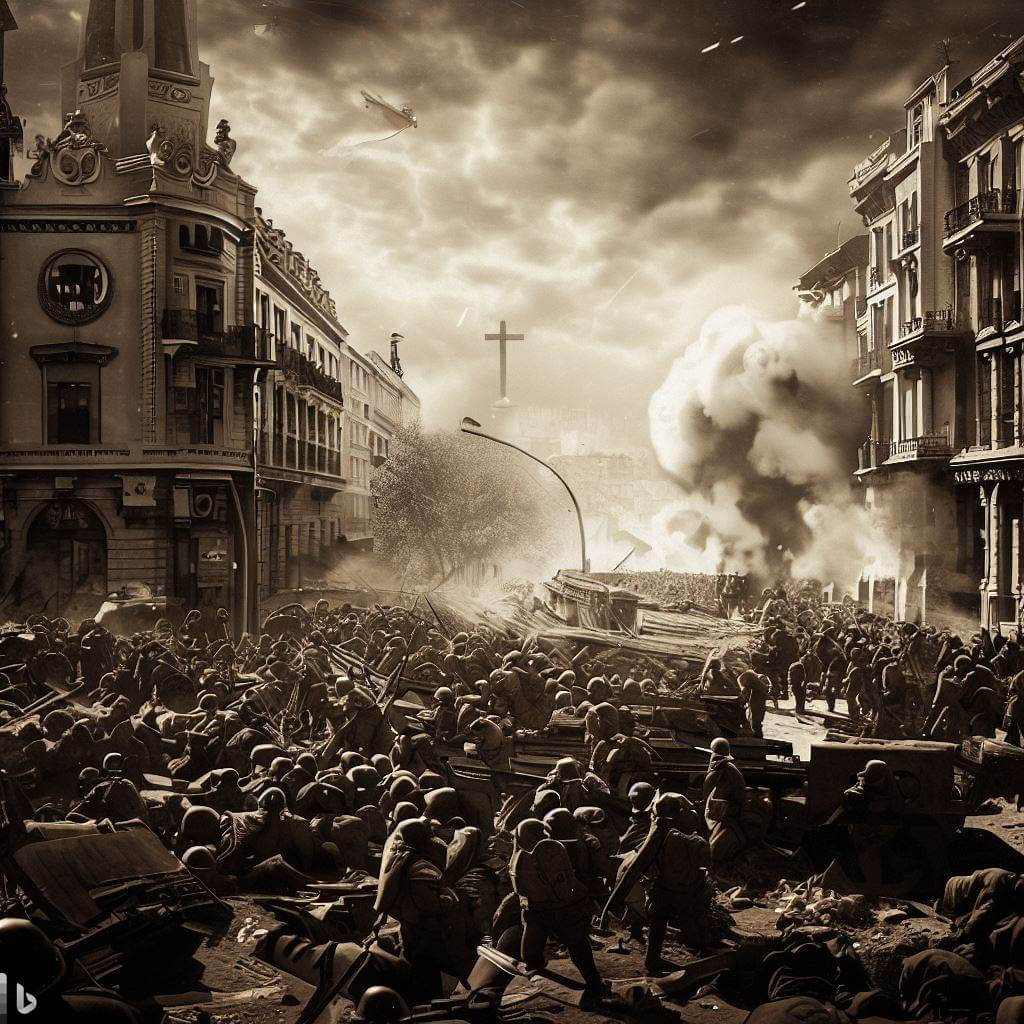
During the Civil War, Madrid was besieged by Francoist forces for more than two years. The city resisted the attacks with the help of the International Brigades and Spanish Republican fighters until Franco’s troops finally entered the city in March 1939.
The Battle of the Ebro
The Battle of the Ebro was the longest and bloodiest battle of the Spanish Civil War and took place in the summer of 1938. It was a major Republican offensive along the Ebro River involving approximately 80,000 soldiers. Although the Republican forces achieved some initial victories, they were ultimately defeated by Franco’s troops.
German and Italian Support for Franco
During the Civil War, General Franco received military and financial assistance from the dictatorships of Germany and Italy. Both countries sent aircraft, tanks and troops to support the Francoist side. This assistance was decisive in Franco’s final victory.
The Republican Exile
Following Franco’s victory in 1939, many Republicans fled Spain to escape repression and reprisals by Francoist forces. It is estimated that more than 500,000 people left the country, many of whom settled in Latin American countries and France.
The Civil War as a Prelude to the Second World War
The Spanish Civil War was seen by many as a kind of prelude to the Second World War. The fascist powers of Germany and Italy supported Franco, while the Soviet Union supported the Republicans.
The Spanish Civil War was also one of the first wars in which propaganda was used as a weapon. Both sides used propaganda to mobilise their supporters and demonise the enemy. Propaganda was also used to recruit foreign volunteers to fight in the war.
After three years of fighting, the Francoist side ultimately emerged victorious. On 1 April 1939, Franco officially announced the end of the Spanish Civil War. His victory had serious consequences for Spain. During Franco’s dictatorship, which lasted until his death in 1975, civil and political liberties were suppressed, dissidents were persecuted and minorities were repressed. Furthermore, the Spanish economy suffered for many years as a result of the destruction and loss of resources caused by the Civil War.
The Spanish Civil War was a complex and devastating conflict that had profound consequences both for Spain and for the wider world. For three years, the country was plunged into a struggle for power and ideology that divided families and communities. Although the war ended more than 80 years ago, it remains a subject of interest and debate for many people and has left an indelible mark on the history of Spain and the world.